# Jensen’s Economic, Precious Metals, & Markets Newsletter
Discover more from Jensen's Economic, Precious Metals, & Markets Newsletter
Economic Events, Precious Metals, Global Silver Squeeze, Political Events
By subscribing, you agree to Substack's Terms of Use, and acknowledge its Information Collection Notice and Privacy Policy.
# Further Data Shows Declining Middle East Crude Exports
Yesterday, the WSJ using Kpler data claimed that Middle East exports of oil from the Middle East (ME) increased to above pre-war levels in the week ending October 18, 2026:
“Middle East oil flows, covering Hormuz cargoes and alternative regional routes, averaged over 24mn barrels per day (bpd) in the week ended Oct 18, compared with 23.3mn bpd before the war, ship-tracking firm Kpler data showed.
The Wall Street Journal, in a report titled More Oil Is Now Coming Out of the Persian Gulf Than Before the Iran War, said preliminary estimates put Hormuz flows, including ship-to-ship transfers in the Gulf of Oman, at about 14mn bpd over the same period, or 82% of prewar volumes…
…Pipelines in Saudi Arabia and the UAE are also carrying crude along other routes. Kpler estimated that around 40% of non-Iranian crude leaving the Gulf in September bypassed the strait, up from 17% before the war. Iran’s own exports, by contrast, remain choked by a US maritime blockade.”
## Oil Data Shows No Increase In ME Oil & Petroleum Fuel Exports
A problem with the WSJ statement is that data from sources other than Kpler indicates exports did not increase last week and are now quickly decreasing.
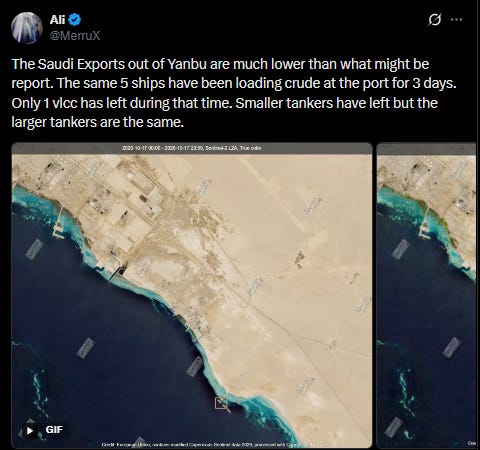
This post of satellite data to October 17 shows very low combined crude / petroleum liquids exports from Saudi’s Red Sea port of Yanbu countering the claim that the Saudi west coast was enabling a large increase in exports: