
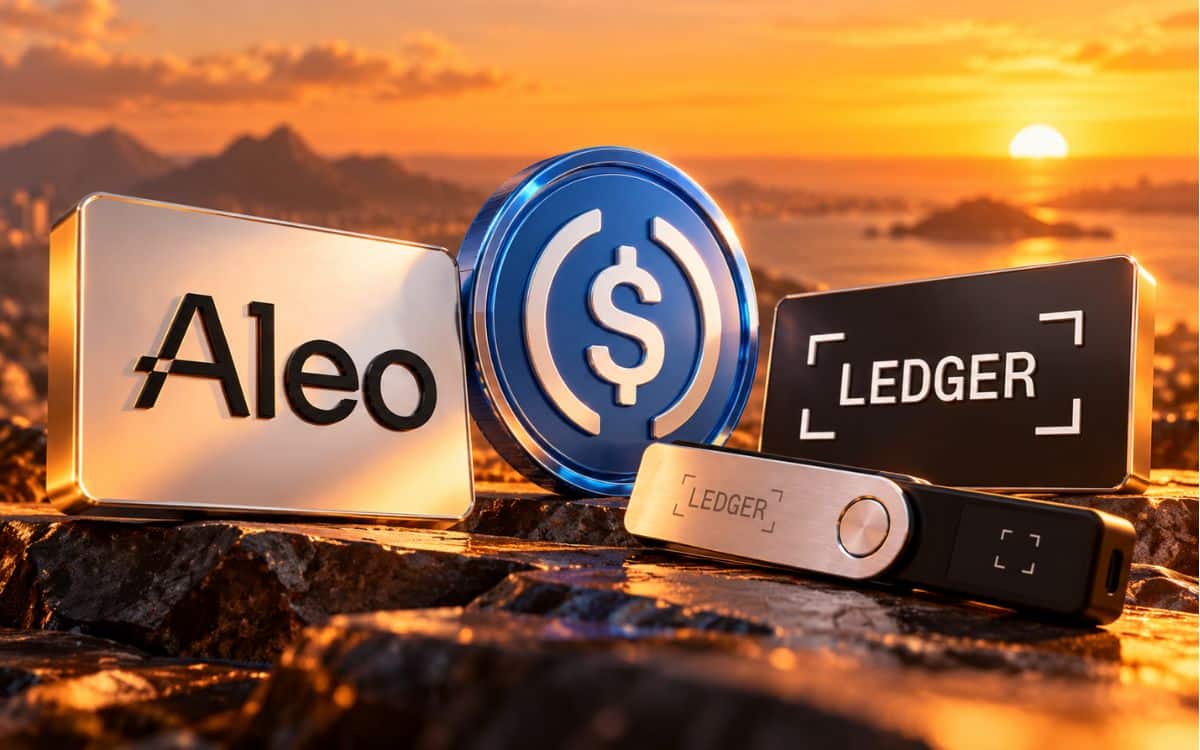
Aleo and Ledger announced on October 1, 2026 that USDCx on Aleo is now supported in the Ledger Wallet app, bringing a privacy-preserving stablecoin to a mainstream hardware wallet for the first time, letting users swap existing stablecoins for shielded USDCx while confirming and signing transactions directly on their Ledger device
Circle Chief Commercial Officer Kash Razzaghi said the launch pairs high-quality reserve assets with onchain visibility and privacy to strengthen the foundation businesses rely on as they scale stablecoin use globally
USDCx is minted through Circle’s xReserve infrastructure, letting Aleo deploy a USDC-backed stablecoin fully interoperable with USDC on supported chains, rather than Aleo issuing the asset independently
Ledger also highlighted the integration in a post on X, marking the addition of privacy-preserving stablecoin support to its hardware wallet ecosystem
Private stablecoins, secured by LedgerUSDCx on @AleoHQ is now supported in Ledger Wallet™.Swap stablecoins you already hold into shielded USDCx, with every transaction confirmed on your Ledger signer's secure screen. pic.twitter.com/jiQNXmKvpz
Aleo says USDCx on Aleo is the first privacy-preserving stablecoin supported by a mainstream hardware wallet. This follows an earlier May 2026 integration in which Aleo became the first blockchain to bring fully shielded zero-knowledge transactions to Ledger hardware for its own native assets, with the new integration extending that privacy architecture to stablecoin transactions specifically
Table 1. How USDCx combines stablecoin backing, blockchain privacy and hardware-secured self-custody
USDCx isn’t Aleo’s only private stablecoin. The network also supports USAD, issued by Paxos Labs and backed 1:1 by USDG, the reserve token of the Global Dollar Network, a reserve approach comparable to the structure covered in USDC’s no-hype breakdown
Holding a stablecoin in a hardware wallet doesn’t automatically make its blockchain activity private, since a transparent network’s address balance and history can potentially be viewed by anyone who connects it to its owner
The integration separates that exposure from custody: Ledger’s hardware secures private keys and lets users approve transactions on the device, while Aleo’s protocol uses zero-knowledge proofs to shield transaction information, a distinction explored further in whether privacy coins are worth it
One technically significant feature is Aleo’s use of a view key. When creating an Aleo account in Ledger Wallet, users approve a view-key request, letting Ledger Wallet display the user’s private balance without giving the application the ability to move those funds, separating balance visibility from spending authority, which remains under the user’s secured keys approved through the device
Aleo is positioning USDCx beyond individual self-custody, pointing to private payroll, business-to-business settlement, and humanitarian aid disbursement. Toku built what Aleo describes as the first production implementation of private stablecoin payroll on the network, a concrete reference point rather than a purely theoretical use case
The underlying requirement is similar across these: users may need to transfer dollar-denominated value without publicly exposing payment amounts or counterparties
The integration also simplifies moving existing stablecoins into the shielded environment. Users can create an Aleo account through Ledger Wallet, approve the view-key request, and use the wallet’s Swap function
With SwapKit as the provider, users can access NEAR Intents, routing swaps across chains without manual bridging, and the final USDCx transaction is reviewed and signed on the Ledger device
USDCx on Aleo is now supported through Ledger Wallet, giving users a route to shield stablecoin holdings while maintaining hardware-based control of their keys
The companies haven’t disclosed transaction volumes, the number of Ledger users expected to adopt USDCx, or the amount of USDCx currently held through Ledger, with the immediate development representing an infrastructure and wallet integration rather than a reported expansion in transaction activity
What this means for you: USDCx on Aleo is now available through Ledger Wallet, combining 1:1 USDC backing, protocol-level transaction privacy, and hardware-secured self-custody. Aleo shields transaction amounts and counterparties through zero-knowledge technology, while Ledger keeps signing keys secured on the device
This article is for informational purposes only and does not constitute financial or investment advice. Stablecoins, self-custody wallets, blockchain networks and privacy technologies involve technology, security, regulatory, custody, liquidity and operational risks. USDCx availability and supported functionality may be subject to applicable terms and jurisdictional requirements
New York and Wyoming Regulators Agree to Coordinate Digital Asset OversightHow Do Crypto Whales Stay Anonymous? Join our growing community Darlene Lleno
Darlene Lleno is a crypto enthusiast and author who was first hooked on Axie Infinity, with SLP (Smooth Love Potion) being her entry point into the world of digital assets. While she still holds SLP, her focus has since expanded to include diverse trading in cryptocurrencies, memecoins, metals, and stocks. Passionate about exploring opportunities across various markets, Darlene shares her insights and experiences to help others navigate the dynamic financial landscape



