Robin J BrooksOct 10, 20265998ShareThank you for subscribing to my posts. If you’re not yet a paying supporter, please consider becoming one. That’ll allow you to DM me with questions and comments. Your contribution will help cover the cost of the data I use in my posts, which I fund out of my own pocket. Thanks so much for your support and feedback!
When bad things happen in government bond markets - the recent rise in French yields most definitely belongs in this category - there’s always lots of finger-pointing about who’s responsible. This’ll typically involve individual transactions that are said to have moved the market - this Bloomberg story on a Japanese asset manager selling out of their French holdings made lots of waves - but this really makes no sense. Debt markets are massive, so who’s to know whether it was this particular thing that moved markets or some other transaction? In the end, instead of scapegoating investors, the blame belongs to policy makers for running endlessly reckless fiscal policy. The main culprit for the French debt sell-off is France itself
It so happens Japan has amazing and timely data on what investments its residents are making abroad, so that’s what I look at in today’s post. It’s certainly true French debt is a popular place for Mrs. Watanabe to invest historically because of the yield pick-up over the safer alternative, which is German Bunds. It’s also true there’s been some selling by Japanese investors, but the bulk of this happened in 2024. There’s no sign there’s been a recent selling wave. My gut is that the finger-pointing at Japan is just the usual scapegoating that happens when bond markets start to struggle. The real blame lies closer to home with French fiscal policy that’s badly broken and an ECB that enables this out of fear for its own survival
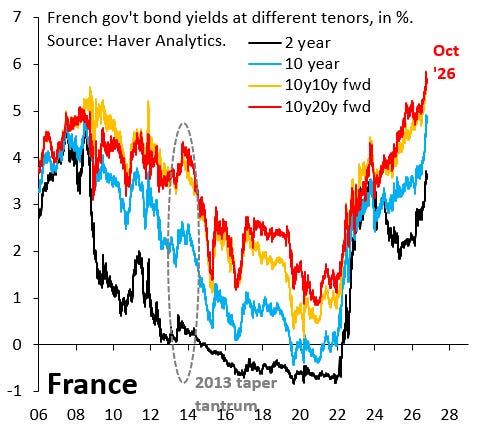
The chart above shows French government bond yields at different tenors and will be familiar to my readers from previous posts. Longer-term yields like 10-year (blue line) and above started going vertical in early August and have continued rising ever since. Indeed, the rise in French yields is far more acute than anywhere else, which of course is what’s gotten the blame game started in the first place. Fortunately, Japan has really good and timely balance of payments data that allow us to see what its residents have been doing. This is what I look at next
Japan publishes monthly data on what its residents invest in overseas. The latest data point is for August, i.e. when the selloff in French debt began. The black line above is a centered 12-month rolling sum of purchases by Japanese residents of long-term debt abroad. When the bars are positive, Japanese investors are buying foreign debt. When they’re negative, they’re selling. The bulk of Japanese flows go to the US (blue bars), but France (orange bars) also gets lots of inflows in ways that are pretty intuitive. Take a look at 2015. The ECB announced its first QE program in January of that year, which was a massive subsidy for any high-debt country and reduced the safe haven appeal of Germany. Predictably, you can see Japanese investors buy France and sell Germany (red bars) right around then. More recently, there’s been selling of France, but this is mainly in 2024 with little sign there’s much going on currently. My best guess is that - when we get data for September and October - this conclusion will continue to hold. Japanese investors are never ones to rattle the cage. They’re cautious and not prone to bold moves, so the blame for the spike in French yields doesn’t belong with them. It rests with France and its endlessly reckless path for fiscal policy