A daily newsletter on everything going on in global macro, covering everything from interest rates, foreign exchange, oil and precious metals prices to sanctions and macro policy
By subscribing, you agree to Substack's Terms of Use, and acknowledge its Information Collection Notice and Privacy Policy.
### The building blocks for yield curve control are falling into place
_Thank you for subscribing to my posts. If you’re not yet a paying supporter, please consider becoming one. That’ll allow you to DM me with questions and comments. Your contribution will help cover the cost of the data I use in my posts, which I fund out of my own pocket. Thanks so much for your support and feedback!_
Fiscal policy in the US is out of control and yesterday’s midterms aren’t going to change that. Quite the opposite. The underlying problem is that the US is so divided politically, so control of the White House and Congress keeps flipping back and forth. With that going on, neither party is ever going to be fiscally responsible because that’s just going to lose you what are already very tight elections. In my view, the only thing that stops us from hurtling towards fiscal oblivion is the formation of a third political party so that the voice of political centrists - who are fiscal conservatives - can finally be heard. Unfortunately, we’re nowhere near that.
So things will get worse before they get better. Back in August, I did a post and live stream on the games high-debt countries play as they start to run out of fiscal space. I flagged three things they do: (i) accuse markets of being irrational when yields start to rise; (ii) lean on central banks to cut policy rates and do QE; and (iii) shorten maturity of debt issuance, which is a devil’s bargain because you’re exposing yourself to much higher rollover risk. If these things sounds familiar, it’s because we’re knee-deep into all of them. Today’s post is an update on how we’re _“gaming”_ debt issuance and yields.
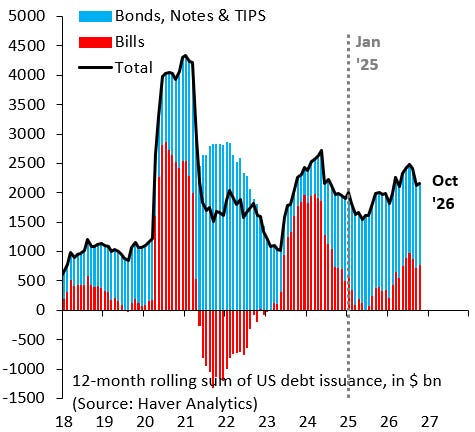
The black line in the chart above shows the 12-month rolling sum of monthly US debt issuance, where the red bars are short-term issuance and the blue bars are everything else. In the year through October 2026, total debt issuance was $2.2 trillion, which is 6.5 percent of GDP and roughly double what we used to do before COVID. The chart also shows that we’re increasingly leaning on short-term issuance to get this done at manageable cost given how much long-term yields have risen. That’s a devil’s bargain as I note above because you’re exposing yourself to much higher rollover risk. There are previous instances where short-term issuance went up a lot, but those differ from where we are now, which is what I discuss next.
The red and blue bars in the chart above are the same as in the first chart, except that they’re now monthly issuance as opposed to a 12-month rolling sum. The black line is the Treasury General Account (TGA), the US Treasury’s checking account at the Fed where cash is parked until it’s needed. There’s two prior cases where short-term debt issuance is heavy. The first is early on in COVID, when the Treasury took advantage of emergency QE to issue lots of short-term debt at low yields. This was prefunding of COVID-era fiscal stimulus. The second is the debt ceiling standoff in 2023 when the TGA was run down to extremely low levels and needed to be refilled quickly using short-term issuance. There’s no such excuses now. There’s no pandemic and no debt ceiling standoff. We’re ramping up short-term issuance because we have to.
All of this comes against the backdrop of the Treasury’s very unusual buyback announcement in August, which followed a sharp bear-steepening in the US yield curve. At the time, Treasury Secretary Bessent put this down to thin liquidity and markets not pricing fundamentals properly. The Treasury sell-off is also the best explanation for the back and forth from the Fed, which shifts hawkish when yields look like they’re about to run out of control. We’re knee-deep into all the games that get played as countries run out of fiscal space and the final destination of all this is yield curvecontrol. Unfortunately, the midterms can’t and won’t change that.
A daily newsletter on everything going on in global macro, covering everything from interest rates, foreign exchange, oil and precious metals prices to sanctions and macro policy
By subscribing, you agree to Substack's Terms of Use, and acknowledge its Information Collection Notice and Privacy Policy.
There is an alternative to all of this, inflating our way out of deep debt. Seems less likely right now than it did a year or so ago but let's not assume it is off the table as the debt crisis deepens. Robin points out that current games won't work so inevitably alternatives will be considered. We need to advocate for whatever it takes to keep inflation at or even slightly below Fed targets despite whatever short-term impact higher interest rates have on financial markets. Warsh teaming up with Bessent to control interest rates is not a good way to solve the debt crisis. Warsh needs to send the signal.....inflation will not become an enabling tool for controlling the debt. Why we didn't send that signal at the last FOMC meeting is a mystery explained only be politics.