A daily newsletter on everything going on in global macro, covering everything from interest rates, foreign exchange, oil and precious metals prices to sanctions and macro policy
By subscribing, you agree to Substack's Terms of Use, and acknowledge its Information Collection Notice and Privacy Policy.
### If the sell-off in French debt worsens, the ECB will obviously intervene
_Thank you for subscribing to my posts. If you’re not yet a paying supporter, please consider becoming one. That’ll allow you to DM me with questions and comments. Your contribution will help cover the cost of the data I use in my posts, which I fund out of my own pocket. Thanks so much for your support and feedback!_
When thinking about France, it’s important to keep in mind two things. First, as far as the ECB is concerned, the inmates are running the asylum. The Euro zone’s high-debt countries have successfully crafted a narrative whereby any kind of sovereign default is seen as an existential threat to the Euro, a shift that began with Draghi’s _“whatever it takes”_ speech in 2012. That’s obviously nonsense. There’s no problem with sovereign defaults inside the Euro. The US is the template for this. Individual states have in the past defaulted, which helps keep their spending under control. So, when people are now scratching their heads if the ECB will bail out France, there’s no doubt it will if things get bad enough. It sees debt crises as a threat to itself. Second, when it comes to ECB bailouts, there’s only one rule: _“there are no rules.”_ Draghi’s _“whatever it takes”_ speech became the OMT, which allowed the ECB to buy short-term debt in return for IMF-style conditionality. Italy and Spain saw this conditionality as an affront to their sovereignty, so - when global yields spiked in 2022 - the TPI got rolled out. The TPI - no surprise - got rid of IMF-style conditionality and allows the ECB to buy all debt maturities across the curve. So when folks now wring their hands about whether TPI can be used for France, that’s missing the forest for the trees. If the TPI can’t be used, there’ll just be a new bailout vehicle. It’s really just that simple.
The ECB likes to pretend it’s got the rigor and discipline of Germany’s Bundesbank from back in the day. That’s why it sweeps all its actions to help high-debt countries under the rug and rolls out tokenGermans to announce its more questionable actions. So, like in 2022, the ECB will try to make it look like it’s not doing anything, when in fact it’ll be intervening to cap yields behind the scenes. In 2022, we only learned with a multi-year delay all the stuff it did to cap Italian and Spanish yields.
This post goes through the list of things the ECB will do to help France and others if the debt sell-off escalates. Initially, it’ll try to fiddle with roll-off of maturing debt on its books for individual countries. There’s little transparency here and this can happen behind the scenes. If that doesn’t calm things down, it can end the roll-off of maturing debt entirely, i.e. end quantitative tightening (QT). If that doesn’t work and there’s questions if TPI can be used for France, it’ll just conjure up an entirely new bailout facility and tell a story - like in 2022 - how this is now the best tool.
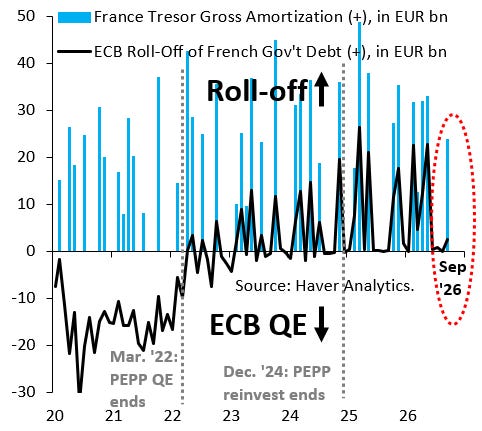
* **Fiddle with debt roll-off for France:** the blue bars in the chart above show the amount of French debt that matures every month. The black line is the amount of French debt that rolls off the ECB’s balance sheet. These two things aren’t going to be the same, since the ECB obviously doesn’t hold 100 percent of any particular debt issue that’s coming due, but - given the huge size of ECB QE in recent years - the black line should be a good way up the blue bars. Something may be going on already. The black line is unusually low versus the blue bar in September 2026, but that could also be noise and reflect low ECB holdings of a particular maturity. This is sort of the point. Transparency on this stuff is low and the ECB can fiddle with lots of things here behind the scenes.
* **Suspend QT entirely:** the ECB is currently allowing government debt that matures to roll off its balance sheet as the chart above shows. It could go back to reinvesting the proceeds from maturing debt, which would help alleviate some of the upward pressure on yields. There’s already some voices from the Euro zone’s high-debt countries - no surprise - calling for this.
* **Invent a new bailout facility:** the ECB has fallen victim to Goodhart’s law whereby the thing you target ends up no longer working. It introduced TPI in 2022 with the express purpose of capping spreads if - in its own assessment - these depart from fundamentals. That’s stopped being useful because spreads are still very tight - so activating TPI isn’t possible - even as real rates are rising fast. As the chart above shows, the real 10-year yield for France just overtook the US, which can’t be welcome. I can see how the ECB responds to this by saying: _“we changed our minds, we’re going to target real yields, not spreads.”_ That’s totally possible. There’s only rule in the Euro zone: _“there are no rules.”_
The ECB likes to drape itself in propriety and virtue signaling, so it’ll start with a bit of behind the scenes fiddling with maturing debt for France. That won’t help much, so then it’ll suspend QT entirely, which also won’t do much. Ultimately, if use of the TPI is in question, it’ll just invent a new tool. We’ve all seen this movie before in 2022.
A daily newsletter on everything going on in global macro, covering everything from interest rates, foreign exchange, oil and precious metals prices to sanctions and macro policy