# French Yields Are Worse Than You Think
### We’re conditioned to look at 10-year yield, but 20- and 30-year yields look way worse
_Thank you for subscribing to my posts. If you’re not yet a paying supporter, please consider becoming one. That’ll allow you to DM me with questions and comments. Your contribution will help cover the cost of the data I use in my posts, which I fund out of my own pocket. Thanks so much for your support and feedback!_
It’s not like France will inevitably go into a full-blown debt crisis. Markets have multiple equilibria where the same fundamentals can have investors cheering one minute and then go into full-on panic mode the next. But it should be pretty clear that violent demonstrations and riots aren’t the kind of optics that’ll help keep France in a good equilibrium, especially with pivotal elections - which are paralyzing the country - still six months away.
There’s a narrative out there that France is _“too big to save.”_ That’s totally wrong. The one thing we know about the ECB is that it sees sovereign debt crises as a threat to its own survival, so it will always come in to tamp things down. That’s what happened in 2022 when a modest rise in Italian and Spanish yields saw the ECB hold an emergency meeting, buy Italian and Spanish bonds behind the scenes, and roll out a new tool to cap yields because Italy and Spain saw existing tools as too onerous. If you think the ECB isn’t going to intervene, you’re missing the forest for the trees.
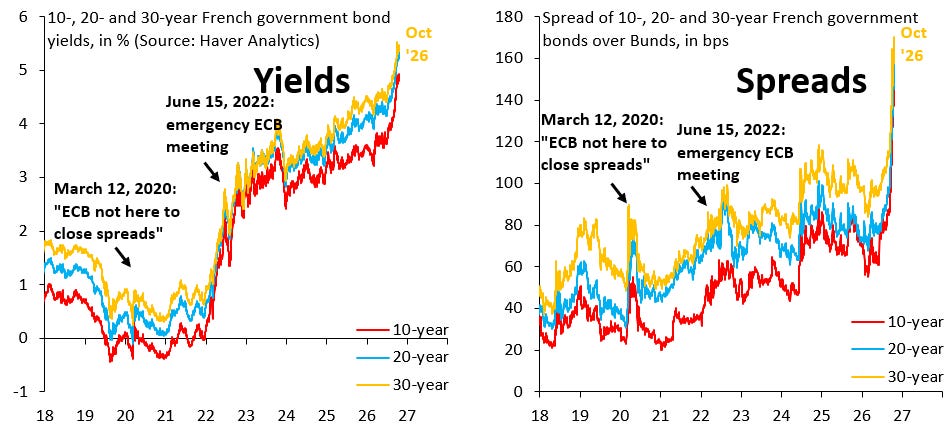
But this still leaves the question how bad things need to get before the ECB steps in. This post is a quick update on French yields, where the picture is worse than widely appreciated. That’s because we’re all conditioned to look at the 10-year yield, which is where ECB actions to artificially cap yields have had the most impact. If you look at 20- or 30-year yields, the picture is way worse.
The left chart above shows daily data for France’s 10- (red), 20- (blue) and 30-year (orange) government bond yields from 2018 through today. The right chart shows the spread of France’s 10- (red), 20- (blue) and 30-year (orange) yields over German Bunds. There’s a fixation on the spread of France’s 10-year yield, which just rose above 150 basis points today, but that misses the fact that this spread is already above 170 basis points for France’s 30-year yield. So things are worse than they appear at first glance, they’re deteriorating rapidly and - once in my opinion we reach 250 basis points on the 30-year spread - it’ll be all-out chaos in the Euro zone and the ECB will be active. In my opinion, there’s strong odds we get there before the end of the year. I have a 30 percent probability on a full-blown debt crisis in France.
A daily newsletter on everything going on in global macro, covering everything from interest rates, foreign exchange, oil and precious metals prices to sanctions and macro policy
By subscribing, you agree to Substack's Terms of Use, and acknowledge its Information Collection Notice and Privacy Policy.
The warning about France’s long-term financing risks deserves attention. However, five-year CDS spreads currently stand at around 70–80 basis points. During the eurozone crisis, Greece’s CDS spreads at times exceeded 2,000 basis points. This substantial gap suggests that markets are not currently pricing in acute fears of a French default. Five-year CDS and thirty-year bond spreads measure different risks, and today’s levels do not rule out a subsequent escalation. Nevertheless, this counterevidence should form part of the assessment: long-term financing pressures are evident, but the CDS market so far offers little support for the view that France is facing an acute default crisis.
The 30-year spread may be the cleaner referendum because it sits furthest from the ECB’s familiar intervention point. If it races toward 250bp while the 10-year stays materially tighter, the curve itself is pricing delayed support.
Gold prices are going through the roof and this isn't due to foreign central banks