A daily newsletter on everything going on in global macro, covering everything from interest rates, foreign exchange, oil and precious metals prices to sanctions and macro policy
By subscribing, you agree to Substack's Terms of Use, and acknowledge its Information Collection Notice and Privacy Policy.
# The End of the Strong Dollar Interregnum
### This year’s Dollar strength has been an interlude due to the war and spiking oil prices
_Thank you for subscribing to my posts. If you’re not yet a paying supporter, please consider becoming one. That’ll allow you to DM me with questions and comments. Your contribution will help cover the cost of the data I use in my posts, which I fund out of my own pocket. Thanks so much for your support and feedback!_
My recent posts and yesterday’s live stream have been making the point that the blue wave at the midterms is highly consequential and spells the end for the war with Iran. Within the Trump administration, a debate is unfolding on how to end things. There’s obviously people who are pushing for another round of military escalation, but what’s new is that opponents of the war - who’d previously held their tongue - are now more vocal. Vice President Vance’s tweet from Wednesday is testament to this.
When I say the war is essentially over, one issue is how to ensure that the Strait of Hormuz remains open without a heavy US Navy presence. In my opinion, that comes down to money. Iran is in terrible shape and the regime is desperate for cash. High oil prices mean the Saudis are minting money. They - along with other oil exporters - can buy off the regime and keep the Strait open that way. What it comes down to at this point is cold hard cash and no amount of bombing changes that.
I have every expectation that Brent falls back to $70 per barrel very quickly once the war is over. We have a _“natural experiment”_ on this from back in June when the MoU was signed. At the time there was lots of talk Brent would be slow to fall as depleted inventories needed to be filled. That ended up not being true at all. Brent fell quickly and sharply. I have no doubt this’ll be repeated now.
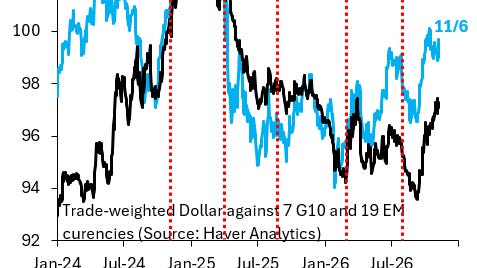
A sharp and permanent fall in oil prices is a big deal for markets. The war interrupted what otherwise would have been a steady fall in the Dollar. Today’s post looks at what going back to Dollar weakness means and which G10 currencies will be fastest to rise as the greenback falls.
The blue line in the chart above is the trade-weighted Dollar against the G10, while the black line is the Dollar versus emerging markets (EM). This year’s Dollar strength is a function of two things: (i) US growth has been outperforming the rest of the G10, in part thanks to AI; and (ii) the war and accompanying uncertainty caused a flight to safety into the Dollar. The latter channel swamps the former channel by a lot, so - as soon as the war ends - safe haven inflows will reverse and weigh on the Dollar. That’ll be especially noticeable against EM where Dollar weakness was most apparent before the war. In my view, Dollar down versus EM is part of the debasement trade because it captures the erosion of institutional quality - things like fiscal dominance and loss of central bank independence - that used to differentiate the G10 from EM.
So how will falling oil prices impact the Dollar? The chart above shows correlations of the daily change in the bilateral exchange rate of the Dollar versus G10 currencies and the daily change in the front-month Brent futures price. I do this for the Dollar versus the Norwegian Krone (NOK), the Canadian Dollar (CAD), the Japanese Yen (JPY), the Euro (EUR), the British Pound (GBP), the New Zealand Dollar (NZD), the Australian Dollar (AUD), the Swiss Franc (CHF) and the Swedish Krona (SEK). I look at five time windows: (i) a long-term window from 2011 to mid-2025 as a kind of base case, before the debasement trade going going (blue); (ii) the heyday of the debasement trade from mid-2025 to early 2026 (red); (iii) the start of the war with Iran until the signing of the MoU in June (orange); (iv) the post MoU truce that fully fell apart with the attack on the East-West pipeline on Sep. 10 (pink); and (v) the post-Sep. 10 period when Brent rose back to its peak from March and April (purple). I’ll focus on the correlations for the most recent time window - the purple bars - for this discussion.
The Dollar rose most strongly against the Swedish Krona when oil went up (on the far right in the chart), followed by the Swiss Franc and Australian Dollar. This is where it will now fall most rapidly as oil prices fall. Conversely, the Dollar may rise against the Norwegian Krone, which is the oiliest of the G10 currencies. In the big picture, the Dollar will fall against everyone, but there’ll be some differentiation and it’s likely to fall most against the Swedish Krona.