A daily newsletter on everything going on in global macro, covering everything from interest rates, foreign exchange, oil and precious metals prices to sanctions and macro policy
By subscribing, you agree to Substack's Terms of Use, and acknowledge its Information Collection Notice and Privacy Policy.
### Nothing good will come from the unprecedented boom in China’s exports
_Thank you for subscribing to my posts. If you’re not yet a paying supporter, please consider becoming one. That’ll allow you to DM me with questions and comments. Your contribution will help cover the cost of the data I use in my posts, which I fund out of my own pocket. Thanks so much for your support and feedback!_
In this week’s posts, I’ve been discussing the completely crazy rise in China’s exports that’s happening at the moment. On Wednesday, I showed how its exports to some of the world’s poorest countries - especially in Africa - are going through the roof, likely creating dependencies that are bad for the countries in question and for the West. In yesterday’s follow-up, I showed how this reorientation of China’s export machine is likely about reducing its exposure to the US in case the trade war heats up again.
I got a lot of questions in response to these posts, so today is a follow-up that shows as much of the raw data as possible so my readers can get a feel for what’s going on. Like I said in my previous posts, I think China is a malignant force in the world. In the four years since Putin invaded Ukraine, China has become Russia’s biggest trading partner by far. In effect, Beijing is Putin’s biggest enabler. The same is true of Iran, where help from China is playing a big role in keeping the regime in the saddle. The new era of Chinese mercantilism will bring more of this. The West needs to be on high alert.
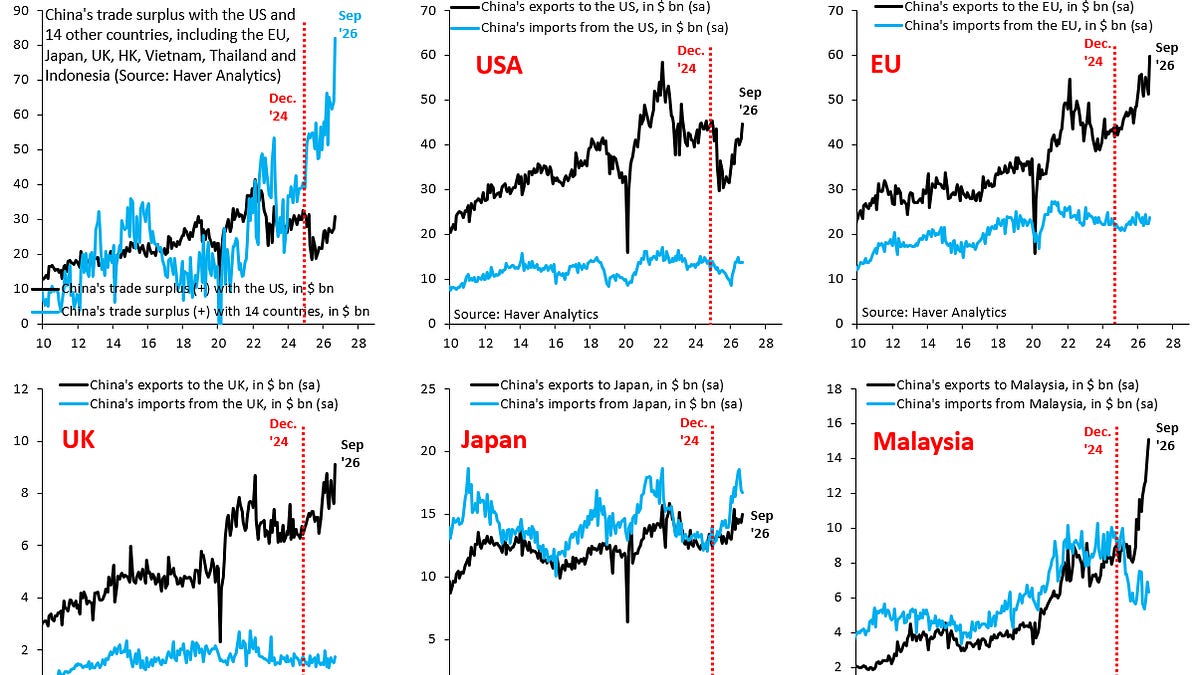
The top left chart above is what generated lots of attention and questions. China publishes seasonally adjusted export and import data for fifteen countries. The black line is China’s trade surplus with the US, while the blue line is its trade surplus with the fourteen other countries. The surplus with the US is back to pre-2025 levels, but it’s the surplus with the other fourteen that’s really going nuts. The other charts show seasonally adjusted monthly exports (black) and imports (blue) for the US (top middle), the EU (top right), the UK (bottom left), Japan (bottom middle) and Malaysia (bottom right). The charts below do the same thing for Mexico (top left), Thailand (top middle), Vietnam (top right), South Korea (bottom left), Taiwan (bottom middle) and Australia (bottom right). I’ll summarize what I think are the key features in these data below.
Besides the massive ramp-up in exports to some of the world’s poorest countries, which I documented on Wednesday, there’s three broad trends in the data:
* **Western consumers:** exports to Western consumer countries are rising rapidly and reached new all-time highs for the EU and UK in September 2026. Exports to the US are back to pre-2025 levels, even though US tariffs remain higher than pre-Trump 2.0. The only outlier is Japan, where China’s exports look quite subdued.
* **Transshipment hubs:** this group includes Malaysia, Mexico, Thailand and Vietnam. It’s here that China’s export growth looks especially crazy, in a way that’s impossible to reconcile with consumer demand in these places. In my opinion, a good chunk of this is transshipment, so this stuff is going elsewhere, including to the US.
* **China’s suppliers:** countries like South Korea and Taiwan export more to China than they import, but even in these cases their imports from China are ramping up rapidly. Australia is another net exporter to China and - again - it’s part of the group of countries where imports from China are at an all-time high.
A caveat to all this is that I’m looking at export values, i.e. price times quantity. It’s possible that higher transportation costs and the AI boom are driving some of this so that quantities are going up by less. But that’s unlikely to explain the reorientation of exports away from the US or the ramp-up in exports to many of the world’s poorest EMs. That’s likely about volumes and not just a price effect.