
The US government sold $728 billion of Treasury securities during the week, spread over eight auctions
Of them, $607 billion were Treasury bills with maturities from 4 weeks to 26 weeks, spread over six auctions. Four of these auctions were over $100 billion each. Most of these sales replaced maturing T-bills. The “investment rate” – which is the yield that is comparable to the yield of notes and bonds – on all of them was over 4%
And $121 billion of the auction sales were 3-year and 10-year Treasury notes and 30-year Treasury bonds. Yields at these three auctions blew through the yield ceiling in a big way, with yields higher than they’d been at auctions in over 20 years, which was what it took to sell all $121 billion of these notes and bonds
And at these higher yields, some more demand emerged, and the bond market settled down and breathed a sigh of relief that it wasn’t any worse
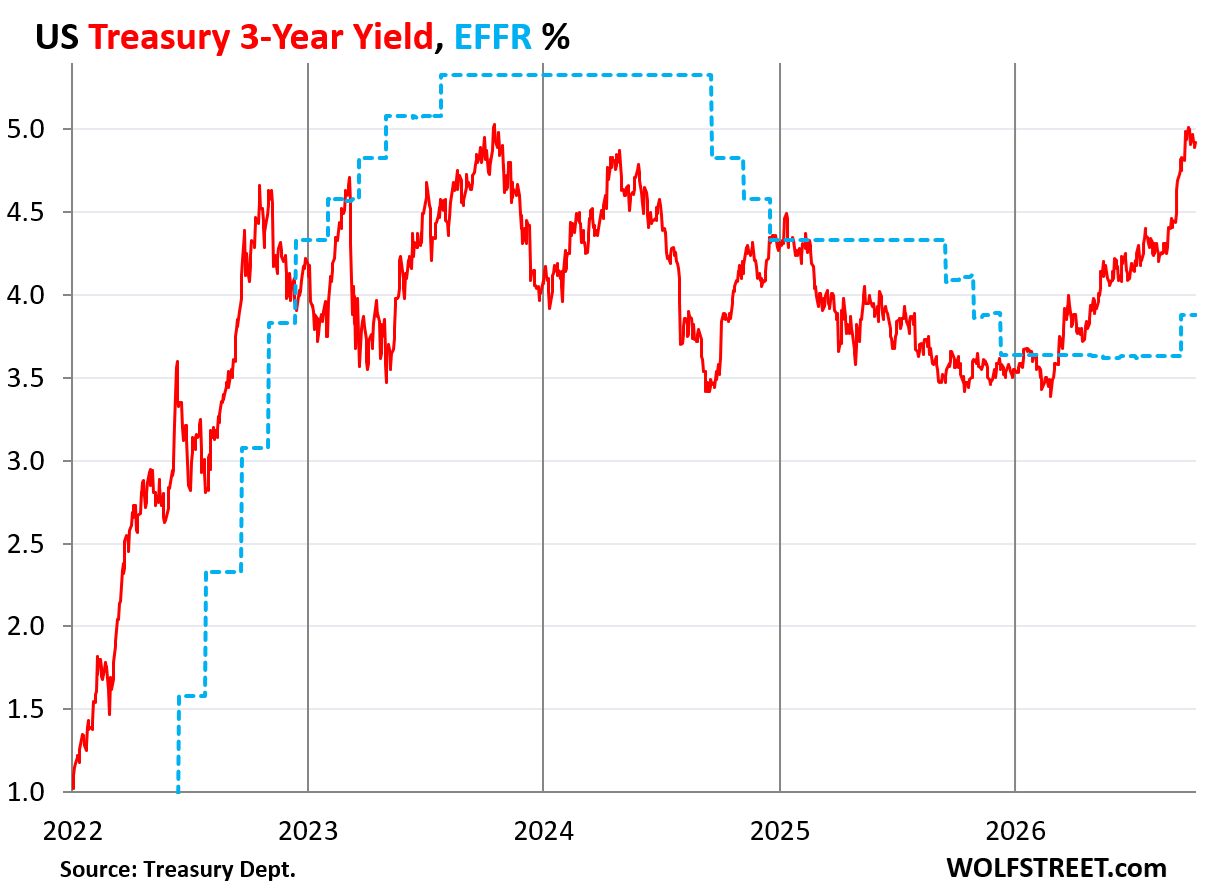
The 3-year Treasury notes sold at auction on Tuesday at a yield of 4.932%, the highest auction yield since the 3-year auction in May 2006, and up from 4.474% at the prior auction a month ago
But in the secondary market, the 3-year yield had already traded at just over 5% in late September, and the day before the auction traded as high as 4.98%. After the auction and for the rest of the week, volatility continued, with yields ranging from 4.88% at the low end to 4.96% at the high end. And it closed the week at 4.92%
Since February, the 3-year yield has surged by 150 basis points, pricing in multiple rate hikes, in addition to the September rate hike
The 10-year Treasury note sold at auction on Wednesday at a yield of 5.30%. That’s what it took to sell all $39 billion of those notes. It was the highest auction yield since November 2000 when yields were declining because the Dotcom Bubble was in full implosion mode by that time, slowing down demand growth and employment growth, which would morph into a recession by March 2001. In the first half of 2000, the 10-year auction yields were in the 6.5% range
The fact that the auction wasn’t worse, that it wasn’t as ugly as the when-issued trading had expected it to be (I discussed the 10-year Treasury auction in detail here), calmed down the market
So, in the secondary market, the higher yield began to pull in some additional demand, and the yield began to edge down right after the auction and closed on Friday at 5.24%
The bond market was very ready to take a breather, after the harsh ride since late February, during which the 10-year yield soared by over 130 basis points at the time of the auction, and now by 125 basis points
Higher yields mean lower prices for existing bondholders who’d bought the notes some time ago at lower yields. That’s the bond bloodbath of rising yields: They crush existing holders. But higher yields are appealing to buyers, and pull in new buyers, and create new demand, and that’s what it took to sell those Treasuries, and that’s the fear of the market that the tsunami of supply of new Treasuries would require still higher yields to rope in new buyers, thereby crushing the buyers who’d just bought
The government deficits continue to pile up at a rate of about $2 trillion a year, and they have to be financed with new debt sales, and those new debt sales have to pull in new buyers. At the same time, AI companies are selling huge amounts of debt at much higher yields – the yield of the SpaceX 10-year notes traded at 7.20% on Friday, nearly 200 basis points higher, at a much higher risk, than 10-year Treasuries, and the government has to compete with those AI bonds
And through it all weaves inflation, which has refused to go back into the bottle. Inflation is the biggest threat that holders of Treasuries with long maturities face over the long term because inflation destroys the purchasing power of long-term investments, and the yield needs to be high enough to compensate them for inflation over the term of the security
Here we’re looking at the first six years of the current bond bear market (when yields rise, bond prices fall) that followed the 40-year bond bull market from 1981 through August 2020 (when yields fall, bond prices rise)
The 30-year Treasury bonds sold at auction on Thursday at a yield of 5.618%, the highest auction yield since the auction in August 2000. That’s the yield it took to sell all $23 billion of bonds
But there were no 30-year bond auctions between August 2001 and 2005, as the government figured that the coming budget surpluses would obviate the need for the long-bond. By 2005, with deficits re-exploding left and right, the 30-year bond was reintroduced. So there was no auction yield during that four-year gap. And there was a period in 2002, when secondary market trading produced yields of 5.8%
In overnight trading before the auction, the 30-year yield was trading as high as 5.72%, and that was the yield that opened the mini-floodgates of demand, and as buyers piled in, the yield dropped sharply before the auction, and so the auction yield was a lot lower than hours earlier, and the bond market breathed another big sigh of relief. Sooner or later, higher yields bring out the demand
On Friday, the 30-year yield closed at 5.60%. Since the end of February, the 30-year yield has risen by 100 basis points. That range of yield in the secondary market is still the highest in 22 years, and over the past two days, it has brought out more buyers
Thirty years is a long time for stuff to go wrong; for inflation to spiral higher; for the fiscal condition of the federal government to spiral down to where even higher inflation is required to deal with it; for the private sector to start looking for a huge amount of capital to build the next big thing, like the AI bonds currently that the government has to compete with…
All kinds of things can happen in 30 years, and investors want to be compensated with higher yields to take those risks
But there is vibrant disagreement among investors about how much risk there is, and these differences in opinions is what makes a market where buyers see deals while sellers want to get the heck out. But the Fed had killed those market dynamics with QE from 2008-2022
At 46 cents on the dollar. The Fed’s QE repressed long-term bond yields. The Fed’s mega-QE starting in March 2020, when it purchased $3 trillion of securities with newly printed money in three months, which repressed the 30-year yield to 1.0%
This interest rate repression recklessly created a generation of long-term securities that became toxic when yields began to rise
For example, in November 2020, the government sold a 30-year Treasury bond (CUSIP 912810SS8) at a yield of 1.68%. That bond has now lost more than half its market value
Here is a price of an official auction: As part of its buyback auctions, the Treasury Department, on October 8, bought back $2 billion at face value of this bond at 46.8 cents on the dollar, paying $936 million for $2 billion of bonds
Several regional banks, topped by SVB and First Republic, collapsed because they had loaded up on long-term bonds at those toxic yields. There was nothing more reckless that the Fed has ever done than the interest rate repression in 2020-2022
The government sold $607 billion of Treasury bills this week, at auction yields that reflected the September rate hike plus expectations of at least one more hike over the next few months
Yields of T-bills react to the Fed’s policy rates and to expectations of the Fed’s policy rates in the near future. They’re less influenced by inflation and supply fears – unlike long-term Treasury securities
And there’s a lot of money now flowing through those auctions. This week, four T-bill auctions were over $100 billion
The $88 billion of 26-week T-bills were sold at the auction on Monday at a “high yield” of 4.165% or at an “investment rate” of 4.314%
In the secondary market, the 6-month Treasury yield closed at 4.32% on Friday, 44 basis points above the Effective Federal Funds Rate (EFFR, dotted blue, 3.88%), which the Fed targets with its policy rates. This indicates that the Treasury market expects at least one rate hike over the next several months within the time window of this maturity
The 6-month yield is a pretty good predictor of changes in the Fed’s policy rates. It started lifting off in early 2026 as inflation began to surge, knocking the Fed off its easing bias
The $102 billion of 13-week T-bills were sold at the auction on Monday at a “high yield” of 4.050% or at an “investment rate” of 4.149%
In the secondary market, the 3-month yield continued to rise and on Friday closed at 4.33%, the way market indices calculate short-term yields (similar to the “investment rate” at auction); and at 4.25% the way the Treasury Department calculates short-term yields (similar to the “high rate” at auction)
In case you missed it: Despite the AI Debt Pileup, Bond Market Still in La-La-Land, Investors Chasing Yield, Backed by Sky-High AI Stock Valuations
Enjoy reading WOLF STREET and want to support it? You can donate. I appreciate it immensely. Click on the mug to find out how
Enter your email address to receive notifications of new articles by email. It's free
