A daily newsletter on everything going on in global macro, covering everything from interest rates, foreign exchange, oil and precious metals prices to sanctions and macro policy
By subscribing, you agree to Substack's Terms of Use, and acknowledge its Information Collection Notice and Privacy Policy.
# How Will Markets Trade the Midterm Elections?
### They won’t - there’s way too much event risk around the restart of a “hot” war with Iran
_Thank you for subscribing to my posts. If you’re not yet a paying supporter, please consider becoming one. That’ll allow you to DM me with questions and comments. Your contribution will help cover the cost of the data I use in my posts, which I fund out of my own pocket. Thanks so much for your support and feedback!_
There’s three scenarios for tomorrow. The first is that Republicans – by some quirk of fate – retain control of Congress. It’s fair to say this would be a huge surprise and is by far the most tradeable of the three scenarios. Markets would trade this as a growth-positive surprise and push up the S&P 500 and the Dollar, much like after Trump’s surprise win in 2016 and the Republican sweep in 2024. The second is that Democrats win the House but Republicans hang on to the Senate. I’d say that’s the base case for most folks and I highly doubt anyone’s excited to trade this outcome. The third is Democrats take both Houses, the fullest possible rebuke to Trump. Some might see this as the most bullish outcome for markets as it’s the biggest constraint on Trump, but I think that misreads what markets care about. After all, they routinely go long China or Turkey where democratic checks and balances don’t exist. Markets care about returns, i.e. growth, not quaint notions of democracy. If you’re skeptical, just think back to this time last year when everyone was convinced the US was losing its reserve currency status. It didn’t and that’s because markets don’t value constraints on someone like Trump. They value growth.
All that said, there’s two more basic reasons why tomorrow’s midterms are likely a non-event for markets. First, no matter what happens, this will be overshadowed by whether the US resumes its bombing of Iran. I did this weekend’sposts and livestreams on how markets will trade if we fall back into a _“hot”_ war. This’ll just totally swamp what happens at the ballot box I’m afraid. Second, even without all this noise, the midterms are usually a non-event. Today’s post looks at what happened in 2022 when there was a widespread expectation there’d be a _“red wave.”_ There wasn’t, i.e. there was a meaningful surprise, but markets didn’t give two hoots about it. They ignored the midterms and my best guess is they’ll do the same now.
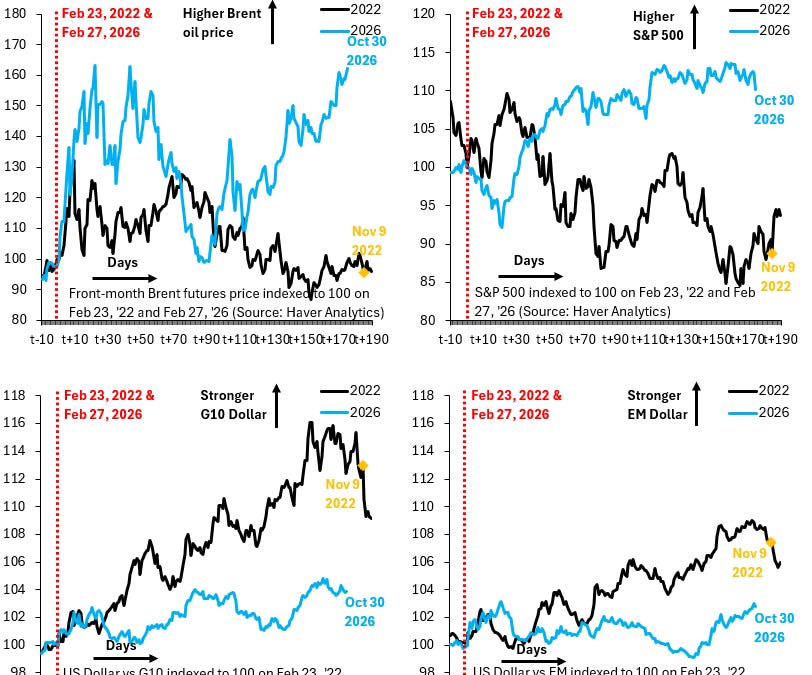
The charts above show the evolution of the Brent oil price (top left), the S&P 500 (top right), the Dollar versus the G10 (bottom left) and versus emerging markets (bottom right). The blue line is what’s happening now in 2026 and the black line is what went on in 2022 when a _“red wave”_ was widely expected at the midterms on Nov. 8. In both years, I’ve indexed things to be 100 the day before war began, which is Feb. 23, 2022, for the invasion of Ukraine and Feb. 27, 2026, for the start of US and Israeli bombing of Iran. The orange rhomboid denotes Nov. 9, 2022, the day after those midterms and I think it shows pretty clearly that markets didn’t trade the surprise lack of a _“red wave.”_ The was a drop in the Dollar towards the end of 2022 and a companion rise in the S&P 500, but that was about the Fed ending its sequence of 75 basis point rate hikes, i.e. giving a signal that monetary tightening would slow.
The four charts above show 30-day ahead implied volatility for crude oil prices (top left), the S&P 500 (top right), the bond market (bottom left) and high yield corporate debt (bottom right). As above, I’ve indexed things to be 100 the day before war starts, i.e. Feb. 23, 2022, for the invasion of Ukraine and Feb. 27, 2026, for Iran. As in the first set of charts, the orange rhomboid denotes Nov. 9, 2022, the day after those midterms and again underscores the lack of any meaningful moves in options markets.
There’s two reason why markets won’t trade the midterms. The first - and by far the more important - is massive event risk around a possible resumption of the _“hot”_ war with Iran. I just don’t think anyone’s going to trade the midterms with this hanging over all of our heads. The second is that - even when things are quiet - the midterms aren’t a big market mover. 2022 is a good illustration because the lack of a _“red wave”_ was a genuine surprise.
A daily newsletter on everything going on in global macro, covering everything from interest rates, foreign exchange, oil and precious metals prices to sanctions and macro policy
By subscribing, you agree to Substack's Terms of Use, and acknowledge its Information Collection Notice and Privacy Policy.