Former central banker, hedge fund manager, and chief economist. Writing sharp global macro insights on debt, geopolitics, and regime shifts. Ex–Bank of Canada, ex–Olayan. Ex Chief Economist at the Prague Finance Institute.
By subscribing, you agree to the publisher's Terms of Service and Privacy Policy, Substack's Terms of Use, and acknowledge its Information Collection Notice and Privacy Policy.
# The Next Recession: What Financial Conditions Are Telling Us
### Why the Yield Curve, Corporate Borrowing Costs, and Equity Markets May Be Signaling a Turning Point in the U.S. Economy
Economic recessions are generally recognized through a deterioration in economic activity, whether reflected in declining output, weakening employment, falling industrial production, or contracting household expenditure. Yet these indicators tell us considerably more about the consequences of a recession **than about the financial mechanisms that initiate one**. By the time employment begins contracting significantly, industrial production is falling, and household spending has entered a sustained decline, the underlying adjustment in investment and financing conditions may already have been underway for several quarters. If our objective is to anticipate a recession rather than merely identify one after it has begun, we must examine the forces that determine whether businesses and households can continue financing their economic decisions.
At the center of this analysis lies a fundamental principle of economics: **investment decisions are determined at the margin**. A business undertakes an investment when its expected risk-adjusted return exceeds the cost of financing that investment. As the cost of capital increases, projects that were previously economically viable become unattractive, even when the business remains profitable and its existing operations continue generating positive cash flows. **The first consequence of tighter financing is a reduction in the number of new investment projects that satisfy the required rate of return**. As this process spreads across businesses and industries, aggregate investment begins to weaken, reducing orders, production, employment, and eventually household income and consumption.
This Substack is reader-supported. To receive new posts and support my work, consider becoming a free or paid subscriber.
This mechanism is particularly important in an economy where businesses depend on credit to finance inventories, working capital, and short-cycle investment. Companies must purchase raw materials, finance production, pay employees, accumulate inventories, and wait for customers to settle their invoices. **The interval between expenditure and revenue creates a continuing demand for short-term financing**, and the cost of that financing influences how much **working capital** businesses are willing or able to employ. When borrowing costs increase sufficiently, firms begin reducing inventories, postponing purchases, and cutting production, even before final demand has deteriorated substantially. What begins as a financial decision at the level of an individual company can become a contraction in aggregate economic activity through the interaction between investment decisions, the inventory cycle, and the income multiplier.
**This distinction is essential because it suggests that a recession can emerge through the supply of financing rather than exclusively through an autonomous collapse in demand**. A business facing higher financing costs may reduce production because maintaining inventories has become uneconomic, while a household may postpone purchasing a vehicle or property because borrowing costs have increased beyond its capacity to service the resulting debt. The reduction in investment and consumption then becomes a reduction in demand for other businesses, which respond by reducing their own expenditure and employment. Consequently, a credit-driven recession can develop through a sequence in which financial conditions deteriorate first, expenditure adjusts second, and the conventional indicators of economic recession respond only subsequently.
#### The Treasury Yield Curve and the Cost of Financing
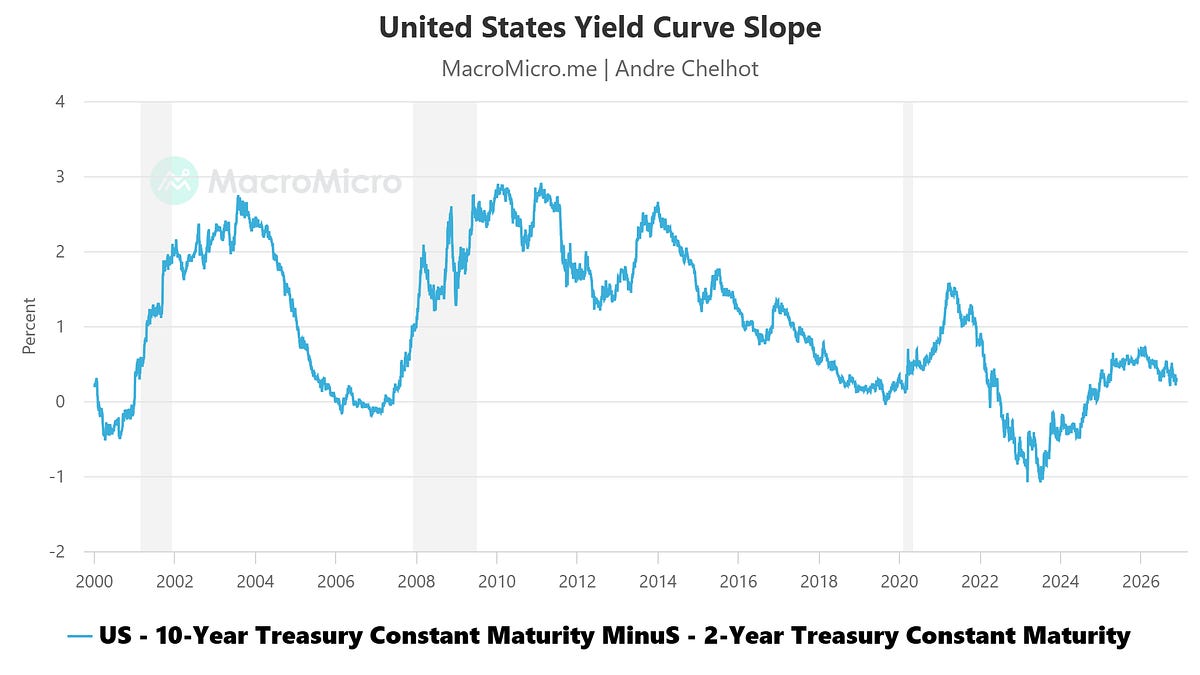
**The Treasury yield curve has traditionally occupied a central position in recession forecasting**. Economists frequently examine the difference between the yield on ten-year Treasury securities and the yield on two-year Treasury securities, with an inverted curve historically preceding several U.S. recessions. The conventional explanation focuses on expectations of future monetary policy: **when short-term interest rates exceed longer-term rates, financial markets may be anticipating that the Federal Reserve will eventually reduce interest rates in response to weakening economic activity**. Although this interpretation contains valuable information, it overlooks another dimension of the yield curve that is particularly relevant for understanding the transmission of monetary policy to the real economy.
The slope of the Treasury yield curve also measures the difference between the cost of financing over different maturities.**Short-term Treasury yields are heavily influenced by the Federal Reserve’s monetary policy, whereas longer-term yields reflect expected future short-term rates, inflation expectations, and term premiums**. When the Federal Reserve increases its policy rate, **the cost of short-term financing generally rises, affecting businesses whose operating cycles require frequent refinancing**. The resulting pressure is especially important for inventories, trade finance, receivables, and working capital, where the economic return on the financed activity must justify the interest expense incurred over a relatively short period.