A daily newsletter on everything going on in global macro, covering everything from interest rates, foreign exchange, oil and precious metals prices to sanctions and macro policy
By subscribing, you agree to Substack's Terms of Use, and acknowledge its Information Collection Notice and Privacy Policy.
### Another 50 or 100 basis points in hikes will do almost nothing to bring down inflation
_Thank you for subscribing to my posts. If you’re not yet a paying supporter, please consider becoming one. That’ll allow you to DM me with questions and comments. Your contribution will help cover the cost of the data I use in my posts, which I fund out of my own pocket. Thanks so much for your support and feedback!_
There’s two things going on with US inflation. First, we’re in a seemingly endless run of supply shocks, including COVID in 2020, the spike in oil prices in 2022 after Russia invaded Ukraine, reciprocal tariffs in 2025 and now the war with Iran. Because there’s long and variable lags in how supply shocks feed into inflation, we don’t know where one shock ends and the next one begins, so it’s hard to know what role supply shocks are playing in recent high inflation readings. Second, the pace of underlying inflation may have risen from before the pandemic. If this is going on, it’s distinct from all the supply shocks that have hit us and would be a sign monetary policy is too loose.
Both things may of course be happening, but here’s the thing. Rate hikes don’t do anything to bring down supply shock inflation and the amount of tightening needed to bring down underlying inflation - if that’s actually risen - is so big that it’d tip the economy into recession. It’s fair to say this Fed doesn’t have the stomach for that, so the hikes we’re talking about are performative, i.e. their purpose is to make it look like the Fed is doing its job. Maybe small hikes help anchor expectations, but - honestly - that falls under _“performative”_ in my book. I’d much prefer for the Fed stay on hold for now and point the finger at the spike in oil prices in September and October, which obviously contaminated this week’s CPI. That said, a 25 basis point hike in December is all but inevitable, but - because of all the ambiguity I discuss here - a 50 basis point hike won’t and shouldn’t happen.
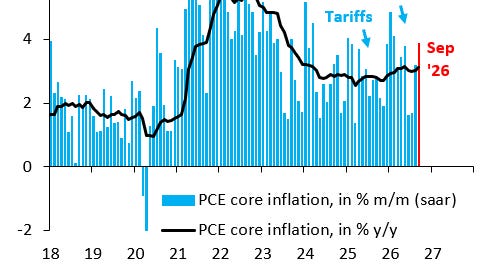
The black line in the chart above is the year-over-year pace of core PCE inflation, which is the Fed’s preferred measure of inflation. The blue bars are the pace of month-over-month inflation, which I’ve annualized to put the two series on the same scale. It should be immediately clear from this chart that: (i) there’s a crazy number of supply shocks in recent years, which I’ve indicated with the blue arrows; and (ii) it’s possible that the underlying trend of inflation has risen since the pandemic. It’s the latter that could be a sign the Fed is behind the curve and needs to hike.
So let’s talk about hikes. In yesterday’s post, I made the point that it doesn’t actually look like US GDP is above potential, which means it’s difficult to see how the latest spike in oil prices could push up underlying inflation. In fact, there’s lots of slack in the global economy, which predisposes me to be skeptical of the inflation scare going on this week. But let’s say we’ve convinced ourselves activity is above potential and we need to cool things down with hikes. The chart above is the Phillips curve, which is the relationship between inflation (vertical) and slack in the labor market (horizontal). The red dots are COVID inflation, the black dots are the war with Iran and the blue dots are everything else. Now draw an imaginary line through the blue dots. It’s really flat, which means you have to drive up unemployment massively to get inflation down even a little bit. This Fed just doesn’t have the stomach for that. That means the hikes we’re talking about are performative, i.e. they’re about making it look like the Fed is being useful. One argument I hear is that some hiking may help anchor expectations, but I think that’s a _“hall of mirrors”_ argument. Expectations go heavily off what actual inflation is as the chart below shows, so expectations are likely to fall back once the oil shock drops out of core PCE inflation.
The bottom line is that the analytical case for three 25 basis point hikes through the end of next year, which is what markets price, is weak. If high inflation is about the Strait of Hormuz and oil, 75 basis points won’t do anything about that. If the issue is that the pace of underlying inflation has risen, then 75 basis points is much too timid to get this under control. In my opinion, it’d be better to wait for the oil shock to pass and then see where underlying inflation settles. All that said, a 25 basis point hike is all but inevitable in December, but a larger hike won’t happen for all the reasons I lay out in this discussion. Better to go slow if you have to go at all.
A daily newsletter on everything going on in global macro, covering everything from interest rates, foreign exchange, oil and precious metals prices to sanctions and macro policy
By subscribing, you agree to Substack's Terms of Use, and acknowledge its Information Collection Notice and Privacy Policy.
The supply shock nobody's counting is electricity. Data centers are pushing power bills up, and hikes don't add a single megawatt. They just make the grid buildout that would fix it more expensive to finance.