Stefan Gerlach writes about monetary policy as it is actually practiced. Based in Zurich, he is Chief Economist at EFG Bank and a former Deputy Governor of the Central Bank of Ireland.
By subscribing, you agree to Substack's Terms of Use, and acknowledge its Information Collection Notice and Privacy Policy.
# France: Will the ECB Invent a New Programme?
##### **Summary:** France’s fiscal problems could develop into a systemic European financial crisis. The ECB’s existing instruments may not be sufficient, and political opposition, particularly in Germany, would complicate intervention. But if European financial stability were threatened, expect the ECB to act by inventing a new instrument.
Thanks for reading Gerlach Macro Notes! Subscribe for free to receive new posts and support my work.
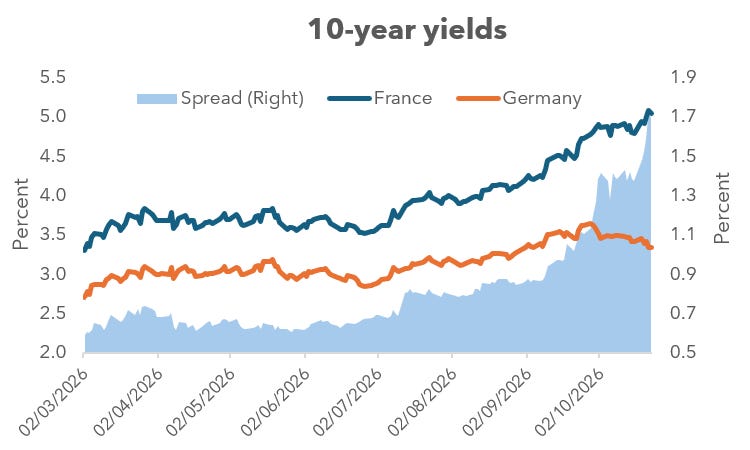
French government bond yields have risen sharply in recent weeks. The ten-year yield has moved above 5%, while the spread over German government bonds has reached 170 basis points, levels last seen during the euro-area sovereign debt crisis. Investors are worried about the lack of political action to address France’s deteriorating public finances.
These tensions raise questions about whether the ECB will intervene. That would be premature now. Higher borrowing costs are a natural consequence of France’s fiscal problems, and there is no evidence yet of a systemic financial crisis. But the situation could deteriorate rapidly.
France’s fiscal problems are not new. It has repeatedly breached the Stability and Growth Pact without serious consequences. In 2016, Jean-Claude Juncker, then President of the European Commission, explained why France received special treatment with the memorable words: “Because it is France.”
But France is different. It is the second-largest economy in the euro area, the EU’s only nuclear-armed state and its only permanent member of the UN Security Council. At a time when Europe worries about its dependence on the United States and Russian political intentions, a serious French crisis would have financial, political and strategic consequences far beyond France itself.
#### **The risk of a European financial crisis**
French government debt is extensively held abroad. Banque de France data show that non-residents held 58.4% of French long-term government debt securities at the end of June 2026, up from 54.6% at the end of 2025. Banks, insurers and other financial institutions hold large quantities of these bonds, which are also used as collateral in secured funding markets.
A sharp fall in French bond prices could generate substantial losses, trigger margin calls and forced selling, and undermine collateral values. Contagion to other highly indebted euro-area governments would be difficult to avoid. A French fiscal crisis risks rapidly becoming a systemic European financial crisis. The ECB would then have to choose between allowing markets to discipline France and intervening to prevent a systemic crisis.