A daily newsletter on everything going on in global macro, covering everything from interest rates, foreign exchange, oil and precious metals prices to sanctions and macro policy
By subscribing, you agree to Substack's Terms of Use, and acknowledge its Information Collection Notice and Privacy Policy.
### There’s a widespread view that France is too small to matter, but that’s wrong
_Thank you for subscribing to my posts. If you’re not yet a paying supporter, please consider becoming one. That’ll allow you to DM me with questions and comments. Your contribution will help cover the cost of the data I use in my posts, which I fund out of my own pocket. Thanks so much for your support and feedback!_
I’ve been doing lots of posts on the debt crisis in France, its causes and how it’s likely to play out. A common pushback I get is that France is just to small to be relevant for global financial markets, which I strongly disagree with. In fact, I did a post last week on how markets are likely to trade through the end of the year. The two risk scenarios around which I structured my views were another spike in oil prices and a full-on debt crisis in France, to which I assign a 30 percent probability.
This is a quick post on why France is systemic for global markets. There are three reasons. The first is that a big part of what’s going on is a cost-of-living crisis, due to high oil prices. That’s a global problem, it’s just that France’s public finances put it on the leading edge of things. France is the canary in the coalmine basically. The second is the implosion of the political center as voters gravitate to the extreme left or right. Again, that’s not a problem unique to France. The rise of the AfD in Germany is very much the same thing and the issue that drives a lot of this - immigration - is of course a common thread across much of Europe. The third is contagion. There’s a long list of high-debt countries in the Euro zone that’s vulnerable to any kind of shock that comes along. France is precisely such a shock.
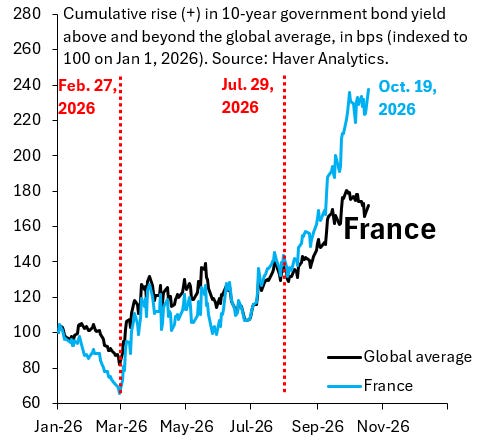
The chart above shows the cumulative rise so far this year in the French 10-year government bond yield (blue) versus an equal-weighted average of 10-year yields across the rest of the G10 countries (black). France’s 10-year yield today rose to its highest level so far this year and the reason is simple. Markets think the government will throw money at the problem, i.e. it’ll try to placate the rioters with concessions that’ll make a bad budget situation even worse. At the same time, whenever the blue line jumps higher, the black line moves up too, i.e. what happens in France spills over into global bond markets. This is because of the three reasons I mention above.
The single most important reason why France is systemic is contagion to the rest of high-debt Europe. The chart above, which shows the spread on 10-year government bond yields over Germany, shows that some of this is already going on. As the French spread has risen recently (red), that’s pulling up spreads all across the rest of the Euro periphery. As I outlined in my roadmap for what’s going on, the ECB will initially try to ringfence the Euro periphery, notably Italy, by intervening to cap yields. But that’s doomed to fail because you can’t cap yields as long as France festers out of control. So the ECB will end up capping everyone’s yield, which distorts fiscal policy incentives even more than they already are. The bottom line is that France is systemic and things will get worse before they get better.
A daily newsletter on everything going on in global macro, covering everything from interest rates, foreign exchange, oil and precious metals prices to sanctions and macro policy
By subscribing, you agree to Substack's Terms of Use, and acknowledge its Information Collection Notice and Privacy Policy.
Gold prices are going through the roof and this isn't due to foreign central banks
Japan's latest fiscal stimulus is sending the Yen into a new devaluation spiral