Discover more from Stay-At-Home Macro (SAHM)
My goal is to make economic policy and macroeconomics better.
By subscribing, you agree to Substack's Terms of Use, and acknowledge its Information Collection Notice and Privacy Policy.
# What will it take to be confident about inflation?
### Risk management, the Fed’s main rationale in September, points to another rate hike next week. Markets put the odds at one in five.
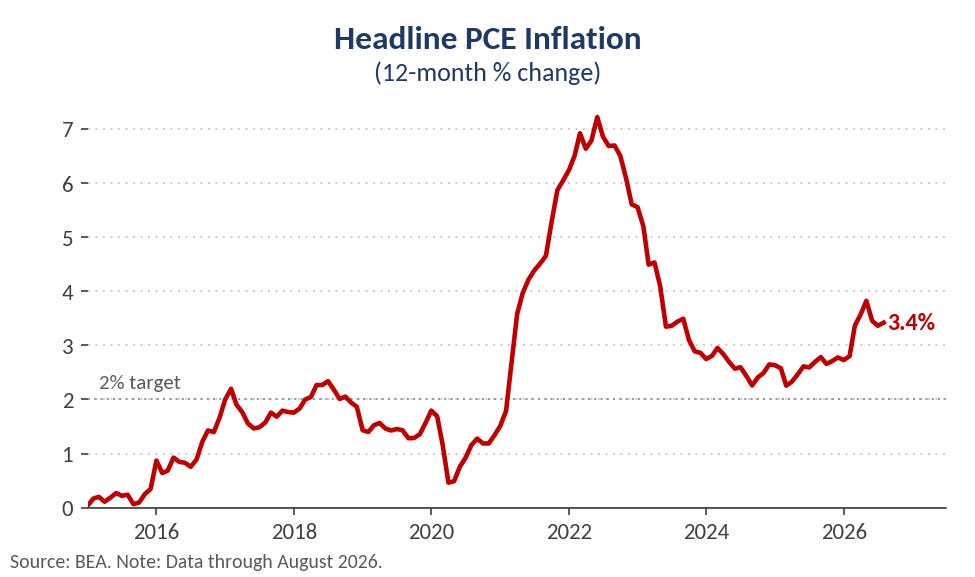
A question I was asked repeatedly this year on Bloomberg: “Are you confident inflation is going back to 2%?” Early in the year, I said yes; the temporary boost from energy prices and tariffs would wane, delivering the necessary disinflation. By the end of the summer, I was much less confident. In September, I shifted to favoring modest rate hikes as insurance against persistently elevated inflation. Risk management was a signature approach of the Powell Fed and was also the most common reason given in the FOMC minutes for the September rate increase.
Information since the September meeting has underscored the upside risks to inflation, while the labor market has remained in balance. Long lags between changes in the policy rate and their effects on inflation argue for adjusting policy sooner rather than later. Other considerations, such as higher long-term interest rates, the timing of the midterm election, and the potential for a market surprise, are insufficient to justify a hold in October. Currently, futures markets implyless than a 20% chance of a rate increase next week, partly reflecting patient messages from Fed leadership in recent weeks. The case for a rate hike is stronger than the odds suggest.
Normally, the outlook for inflation and employment drives the Fed’s decisions about the appropriate federal funds rate. Because interest-rate changes take time to work their way into economic outcomes, today’s appropriate policy rate hinges on beliefs about inflation and employment a year or two out. Many of the shocks underlying inflation have causes external to the economy: military conflicts in the Middle East and Ukraine, the ratcheting up of tariff rates to promote domestic production, large swings in immigration policy, and an emergent general-purpose technology in artificial intelligence. Uncertainty around these shocks means a baseline forecast is insufficient. Central bankers must also consider risk scenarios.
Risk management does not bias the FOMC toward holding rates steady. Gathering more information may help under uncertainty, but waiting is not costless when inflation is elevated, and additional inflationary pressures remain. If inflation proves to be higher next year, the FOMC cannot go back to the October 2026 meeting and raise rates. However, if inflation comes in lower than expected, it can cut rates and reverse some of the restriction. That reversal is relatively cheap from where policy sits today: one quarter-point increase from a level most officials describe as around neutral or only slightly restrictive. Raising rates modestly now as insurance against upside inflation risks is, in principle, the mirror image of cutting rates modestly last year as insurance against downside employment risks.
Uncertainty about the supply-side shocks hitting the economy is heightened, and there is always some uncertainty about how monetary policy works through the economy. How much is enough to bring inflation down? The Fed has one tool, interest rates, and how sensitive overall demand is to rate changes is complicated. Fed Governor Bowman has argued that, under uncertainty, it is best to move slowly and see how the economy responds before raising rates again. Cleveland Fed President Hammack has made the opposite case, for “small adjustments relatively quickly.” Timing isn't everything in monetary policy; October versus December is not pivotal. But waiting can raise the odds of a catch-up later. I still have the four consecutive 75-basis-point hikes in 2022 seared into my brain. It worked, but I wouldn’t want the Fed to test it too often.
The standard for raising rates that Warsh offered at Jackson Hole in August evokes risk management by centering on confidence:
> We must be confident that underlying inflation is moving to our objective, clearly and at sufficient speed. Otherwise, we have work to do.