Since I will be in Singapore next week, I decided to take a closer look at the MAS’ upcoming policy decision. As regular readers will know, I am a great admirer of the MAS and its remarkable record of maintaining price stability over the past four decades
Singapore is unusual because the MAS conducts monetary policy through the exchange rate rather than a short-term interest rate. It manages the Singapore dollar against a trade-weighted basket of currencies, allowing it to fluctuate within an undisclosed band. Monetary policy is tightened principally by increasing the rate at which this band appreciates
The MAS has already tightened twice this year. In April, it increased the rate of appreciation of the policy band “slightly”. In July, it tightened again, announcing that it would increase the rate of appreciation “very slightly”. The question is whether it will move for a third consecutive time in October
There is certainly a case for doing so. Inflation has risen noticeably during 2026. Core inflation increased from 1.6% in June to 2.0% in July and 2.2% in August, its highest rate in almost two years. Headline inflation has also risen, reaching 2.3% in August. The MAS and Ministry of Trade and Industry now judge the risks to the inflation outlook to be tilted to the upside and expect core inflation to remain elevated into 2027
Much of the increase reflects the rise in global energy prices. Electricity and gas inflation reached 8.7% in August
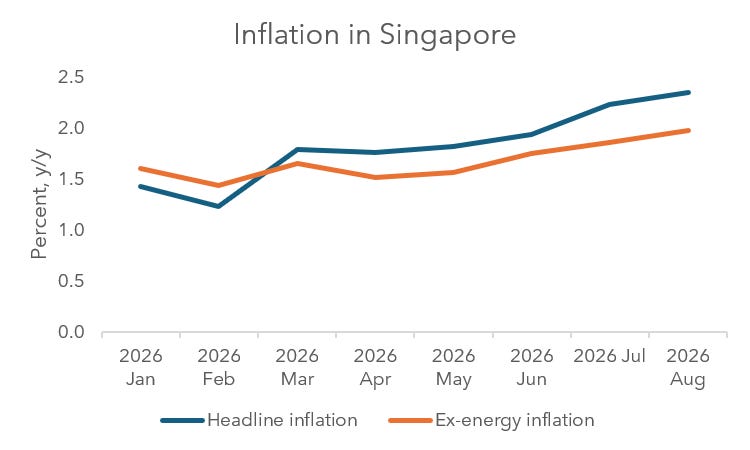
To get a sense of the direct contribution from energy, I constructed a rough measure of inflation excluding electricity, gas and motor fuels. This is not an official SingStat series, and it removes only the direct effect of higher energy prices: any indirect effects working through the prices of other goods and services remain. Using the unrounded index levels, headline inflation reached 2.35% in August, compared with 1.98% on this measure. The gap of about 0.4 percentage points suggests that direct energy prices account for a meaningful part of current inflation
Source: My calculations using data from SingStat
But that is not the whole story. My ex-energy measure has itself risen from around 1½% at the beginning of the year to almost 2% in August. The increase in inflation therefore extends beyond the direct effect of higher energy prices
That broadening is probably what the MAS will be watching most closely. An increase in imported energy prices does not by itself require a monetary-policy response. But the argument for tightening becomes stronger if higher energy costs start feeding persistently into the prices of other goods and services
So far, however, the risk of a broader inflation process should not be overstated. Domestic cost pressures appear relatively contained. MAS and MTI expect services unit labour costs to rise more slowly, reflecting sustained productivity growth and moderating nominal wage growth. They also expect enhanced government subsidies to continue dampening services inflation
There is also a case for patience. The MAS has already tightened twice this year, and monetary policy works with long lags. MAS estimates that the peak impact of changes in exchange-rate policy occurs only after four to six quarters. The full effects of the April and July moves therefore have yet to be felt
This leaves the MAS with a finely balanced decision. Inflation is moving in the wrong direction, the increase is no longer confined to the direct effects of energy, and the risks remain tilted to the upside. But much of the current inflation impulse still originates abroad, domestic cost pressures remain contained, and two earlier tightening moves are still working their way through the economy
The October meeting is therefore genuinely live. The key question is not whether Singapore has experienced an energy shock. It plainly has. It is whether that shock is developing into a broader inflation process. The August data provide some evidence that it is spreading
In the MAS’ September Survey of Professional Forecasters, 45% of respondents expected another tightening in October. I would put the probability somewhat higher. The two earlier moves and contained domestic cost pressures argue for patience. But with inflation continuing to broaden beyond the direct effects of energy, and the MAS itself judging the risks to inflation to be tilted to the upside, I think another tightening is more likely than not